Conceal me what I am, and be my aid for such disguise as haply shall become the form of my intent.
- Twelfth Night, I.ii
As I mentioned above, I am participating in Ian Doescher's Shakespeare 2020 Project, and the first play was Twelfth Night. Written somewhere around 1601 or 1602, the play is largely considered the last of Shakespeare's real comedies before he moves into his more mature "problem play" era.* It relies heavily upon established tropes of the time - mistaken identities, master/servant protocols, marriage as a happy ending, and - most notably - cross-dressing and gender confusion.
The play begins, of course, with the shipwreck of Viola and Sebastian upon the foreign shore of Illyria, a country which seems to be undergoing some sort of revel for the three-month period over which the play is set. The twins are separated, and both assume the other dead. Immediately Viola begins dressing as a man and feigns the name "Cesario" to take up employment under the local duke, Orsino.
Viola has been played by a host of actresses in our modern era, with directors setting the stage from Regency England to the Edwardian era, to fantasy scenery, and beyond. Costuming-wise, however, almost all productions feature Viola's "Cesario" scenes with her in some type of uniform. Take the most famous recent film production from 1996. Here, Imogen Stubbs plays Viola, in a version set in what appears to be turn-of-the-century England. Stubbs' Viola/Cesario is dressed in military costume.

In 2009, similarly, Anne Hathaway played Viola in New York's Shakespeare in the Park, with similar effect, this time as a Regency-era soldier, seen here with Raúl Esparza.

Even the 2006 modernization of the play, "She's the Man," has Amanda Bynes in a private school dress jacket (left.)

Lest you think this is merely a modern affectation, even the earlier versions of the play feature its actresses in the uniform of servant's livery. See below, with Vivien Leigh as Viola (with Trader Faulkner as Sebastian) in 1955 at Stratford, or Judi Dench in 1969 at the Royal Shakespeare Company (those boots with the crenellated tops!! *dies*)


What does it say about us as a society that the most "masculine" form of dress, or the one that most clearly indicates "male-ness," is that of a standardized uniform? The very word implies "sameness." Of course, the audience does need some sort of visual indication of the difference between Viola-as-woman and Viola-as-Cesario. But why no other options than that of a uniform?
At first glance, in a modern play setting, this seems sort of straightforward - young woman disguises herself as young man. But any historian knows that women were not allowed upon the stage in Shakespeare's day, which means that Viola would have been played by a man; in fact, most likely she would have been played by a boy old enough to appear like a young woman, but young enough for his voice not to have dropped yet. This means that Viola would have actually been a young man playing a woman playing a young man. Modern productions often skip over this difficulty altogether.
One does not, however. A production I would sacrifice my left kneecap to have seen live is the 2012 Globe Theatre's version, directed by Tim Carroll and and starring Mark Rylance as Olivia and Johnny Flynn as Viola. Costume designer Jenny Tiramani won a Tony award for her designs, as she strove to create the most historically-accurate costumes possible for the production. Star Mark Rylance wore period-correct stays which he claimed limited his range of motion** and developed a particular floating walk which emphasized the almost legless, alien quality of the character of Olivia. You can see Tiramini's designs and Rylance's movement within them here and here.*** Her designs were not the only historical accuracy: as in Shakespeare's day, director Carroll chose to cast all male actors, forcing his audience to avoid the mental shortcuts available to other productions. What does this do to us as we consider gender within the contexts of the play?
What is most immediately striking is how the costuming highlights the ambivalence of gender in the 2012 production. If we allow our modern perceptions of masculinity to intrude upon them, the dress of the male characters of "Twelfth Night" seem downright effeminate. The lace and frills of Liam Brennan's Orsino and the powder and gilt of Flynn's Viola/Cesario leap out at us as surely belonging to more feminine characters, while Olivia's stark black mourning and stillness fall more in line with the (male) uniform of modern productions.


Without our modern sensibilities getting in the way, the production is forced to rely on the words of the playwright, the skills of the actors, and the range of historical knowledge of the audience. By all accounts, it was an immensely successful performance, and a tribute to how close attention to historical detail does not need to be pedantic or peevish - it can, indeed, contribute to the themes of a play.
Not to leave out our other two ladies, let's just check in with Maria, the scheming, petite little "firago" servant of Olivia's. She, too, would have been played by a young boy, and lines in the play suggest that she would have been depicted by a younger one than Viola or Olivia, since she is often described as petite or small. Paul Chahidi played her on the Globe's stage in 2012.
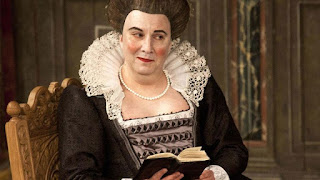
Other versions of Olivia are more typical of the "leading lady," but this blog post wouldn't be complete without mentioning Bonham-Carter's lustrous fragility, or Kara Tointon's 2017 RSC version, set in Victorian England, which allows it to use all those carefully-coded messages involved in corsetry and bustles and hair all bound up or loosely flowing.


Next up: Henry VI, Part 1!
- - - - - - - - - - - - - - - - - - - - - - - - - - - - - - - - - - - - - - - - - - - - - - - - - - - - - - - - - - - - - - - - - - - - - -
* Doescher scheduled it first, despite its late date, so that it would coincide with the actual date of the twelfth night of Christmas, January 6. Nevertheless, the play itself doesn't seem to refer to any Christmastide activities, and takes place over a period of three months. Anne Barton's excellent introduction in the Riverside Shakespeare provides an overview of the best scholarship we currently have regarding the title's intent, as well as the play's first performance date.
** To this, I add a bit of a "harrumph," as they, frankly, shouldn't. Stays and corsets, properly fitted, shouldn't limit movement or breathe in any way. However, as an actor who is accustomed to breathing in a particular fashion, or who wishes to add drama to an interview, I'll allow it.
*** I have to admit, my first experience with this costume was actually costumer Zack Pinsent's interpretation of it from earlier this year. I came across this video, which initially was mistakenly labeled by its sharer as being a costumer on a hoverboard. While a unique concept, and one I would be interested in seeing, it's not what's happening here, though it's easy to see why a casual viewer would believe it. Neither Rylance nor Pinsent are on hoverboards - they are just immensely talented body movement artists: Zack Pinsent as Olivia.

In 2009, similarly, Anne Hathaway played Viola in New York's Shakespeare in the Park, with similar effect, this time as a Regency-era soldier, seen here with Raúl Esparza.

Even the 2006 modernization of the play, "She's the Man," has Amanda Bynes in a private school dress jacket (left.)

Lest you think this is merely a modern affectation, even the earlier versions of the play feature its actresses in the uniform of servant's livery. See below, with Vivien Leigh as Viola (with Trader Faulkner as Sebastian) in 1955 at Stratford, or Judi Dench in 1969 at the Royal Shakespeare Company (those boots with the crenellated tops!! *dies*)


What does it say about us as a society that the most "masculine" form of dress, or the one that most clearly indicates "male-ness," is that of a standardized uniform? The very word implies "sameness." Of course, the audience does need some sort of visual indication of the difference between Viola-as-woman and Viola-as-Cesario. But why no other options than that of a uniform?
At first glance, in a modern play setting, this seems sort of straightforward - young woman disguises herself as young man. But any historian knows that women were not allowed upon the stage in Shakespeare's day, which means that Viola would have been played by a man; in fact, most likely she would have been played by a boy old enough to appear like a young woman, but young enough for his voice not to have dropped yet. This means that Viola would have actually been a young man playing a woman playing a young man. Modern productions often skip over this difficulty altogether.
One does not, however. A production I would sacrifice my left kneecap to have seen live is the 2012 Globe Theatre's version, directed by Tim Carroll and and starring Mark Rylance as Olivia and Johnny Flynn as Viola. Costume designer Jenny Tiramani won a Tony award for her designs, as she strove to create the most historically-accurate costumes possible for the production. Star Mark Rylance wore period-correct stays which he claimed limited his range of motion** and developed a particular floating walk which emphasized the almost legless, alien quality of the character of Olivia. You can see Tiramini's designs and Rylance's movement within them here and here.*** Her designs were not the only historical accuracy: as in Shakespeare's day, director Carroll chose to cast all male actors, forcing his audience to avoid the mental shortcuts available to other productions. What does this do to us as we consider gender within the contexts of the play?
What is most immediately striking is how the costuming highlights the ambivalence of gender in the 2012 production. If we allow our modern perceptions of masculinity to intrude upon them, the dress of the male characters of "Twelfth Night" seem downright effeminate. The lace and frills of Liam Brennan's Orsino and the powder and gilt of Flynn's Viola/Cesario leap out at us as surely belonging to more feminine characters, while Olivia's stark black mourning and stillness fall more in line with the (male) uniform of modern productions.


Without our modern sensibilities getting in the way, the production is forced to rely on the words of the playwright, the skills of the actors, and the range of historical knowledge of the audience. By all accounts, it was an immensely successful performance, and a tribute to how close attention to historical detail does not need to be pedantic or peevish - it can, indeed, contribute to the themes of a play.
Not to leave out our other two ladies, let's just check in with Maria, the scheming, petite little "firago" servant of Olivia's. She, too, would have been played by a young boy, and lines in the play suggest that she would have been depicted by a younger one than Viola or Olivia, since she is often described as petite or small. Paul Chahidi played her on the Globe's stage in 2012.

Other versions of Olivia are more typical of the "leading lady," but this blog post wouldn't be complete without mentioning Bonham-Carter's lustrous fragility, or Kara Tointon's 2017 RSC version, set in Victorian England, which allows it to use all those carefully-coded messages involved in corsetry and bustles and hair all bound up or loosely flowing.


- - - - - - - - - - - - - - - - - - - - - - - - - - - - - - - - - - - - - - - - - - - - - - - - - - - - - - - - - - - - - - - - - - - - - -
* Doescher scheduled it first, despite its late date, so that it would coincide with the actual date of the twelfth night of Christmas, January 6. Nevertheless, the play itself doesn't seem to refer to any Christmastide activities, and takes place over a period of three months. Anne Barton's excellent introduction in the Riverside Shakespeare provides an overview of the best scholarship we currently have regarding the title's intent, as well as the play's first performance date.
** To this, I add a bit of a "harrumph," as they, frankly, shouldn't. Stays and corsets, properly fitted, shouldn't limit movement or breathe in any way. However, as an actor who is accustomed to breathing in a particular fashion, or who wishes to add drama to an interview, I'll allow it.
*** I have to admit, my first experience with this costume was actually costumer Zack Pinsent's interpretation of it from earlier this year. I came across this video, which initially was mistakenly labeled by its sharer as being a costumer on a hoverboard. While a unique concept, and one I would be interested in seeing, it's not what's happening here, though it's easy to see why a casual viewer would believe it. Neither Rylance nor Pinsent are on hoverboards - they are just immensely talented body movement artists: Zack Pinsent as Olivia.
